Explore our work
Food, Water and Climate
More efficient water use, less food loss and cooling that uses less energy.
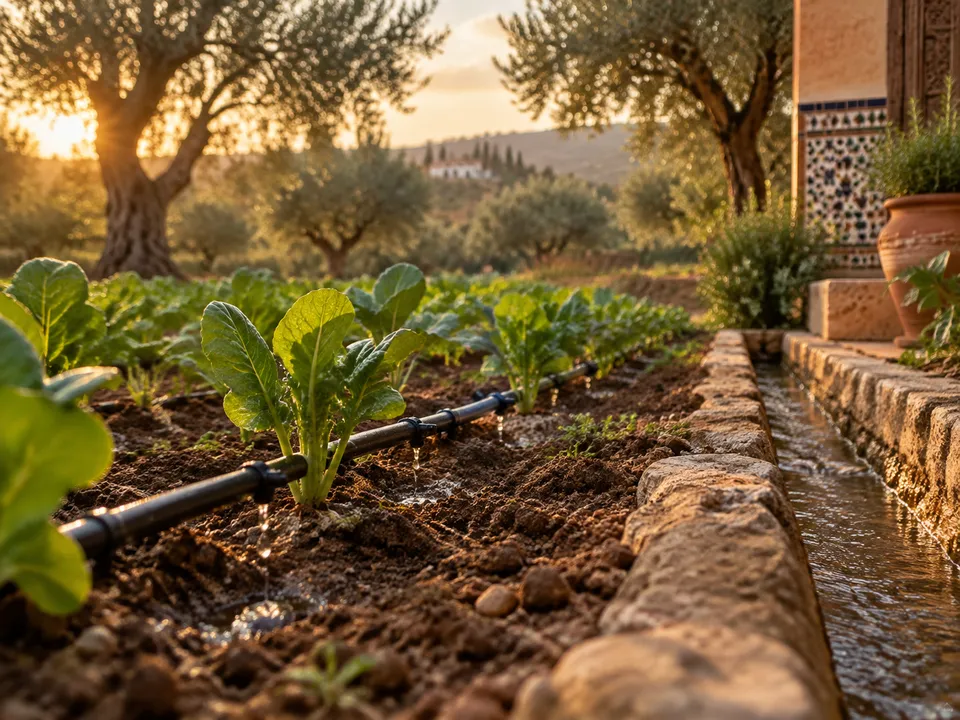
Area for future partnership
- Our focus
- More efficient water use, less food loss and cooling that uses less energy.
- Collaborate
- Ways to get involved
Why it matters
Water, food and heat pressures meet in everyday places: a farm deciding when to irrigate, a market trying to keep produce fresh, or a building that must remain usable through hot weather. Losses and interruptions can affect household budgets, farmers’ income and the reliability of essential services.
We start with a specific loss or reliability problem and the people responsible for solving it. Understanding operating costs, available skills and maintenance matters as much as the technology: a solution has to keep working after installation.
What we may explore
Possible contributions include finding and reducing water losses, preserving food after harvest and making efficient cooling easier to adopt. A useful first project could follow one crop, distribution route or building, establish a baseline and test a change with the people responsible for day-to-day operations.
We would consider actual water withdrawals or leakage avoided, food losses by weight and value, farmer income, electricity use, equipment uptime and operating cost. Better efficiency does not automatically reduce total water consumption if use expands elsewhere. Measurement should capture the overall effect, including affordability and the ability to repair and maintain the solution locally.
With water authorities, municipalities and food-system operators, we aim to develop shared planning and coordination tools for resource availability, infrastructure maintenance, storage and distribution. Aggregate operational information could support drought, heat and disruption responses. Clear data responsibilities, interoperable systems and access limited to each operational purpose would help institutions coordinate across locations while retaining accountable decisions.
What we learn from the evidence
Evidence and sources
Water resources are scarce
The World Bank reported average annual water availability of 480 cubic metres per person in MENA in 2023. This regional resource measure does not describe household drinking-water access or every country’s situation. It helps explain the importance of managing demand and reducing avoidable losses.
Heat adds pressure
WMO’s December 2025 assessment found that 2024 was the hottest year in its record for the Arab region, 1.08°C above the 1991–2020 average. The report describes intensifying heatwaves and droughts. Its Arab-region geography differs from MENA, so the findings should be read within that scope.
Food systems extend beyond farms
The World Bank’s 2026 Building Food Security, Creating Jobs report estimates that nearly one-third of food is lost or wasted between farms and consumers across MENA plus Afghanistan and Pakistan. Its recommendations include better storage and logistics, water productivity and more resilient trade.
Cooling needs a whole-system view
UNEP and FAO’s 2022 global cold-chain report explains how refrigeration can protect food while also using energy and producing refrigerant emissions. Its systems approach is relevant to local projects, but is not a MENA-specific impact estimate. Power, maintenance and operating costs need attention alongside equipment.
For Ghars, these findings favour focused improvements that operators can measure and sustain. Regional evidence establishes why the problem matters; it does not establish which intervention will work at a particular site.
Sources and further reading
Evidence and sources
- In MENA, make every drop of water count
Regional context and practical priorities for water management.
- Temperature increase is accelerating in the Arab region
Official summary of the State of the Climate in the Arab Region 2024 report.
- Building Food Security, Creating Jobs
Report overview, key findings and a link to the full publication.
- Sustainable Food Cold Chains: Opportunities, Challenges and the Way Forward
A guide to the benefits and environmental trade-offs of food cooling.
Help move this work forward
Water operators, farmers, agronomists, food businesses, logistics and refrigeration specialists can help identify a specific loss or reliability problem. Researchers can contribute methods, local evidence and ways to test whether an improvement lasts across seasons and operating conditions.
We welcome potential project and funding partners interested in discussing a defined pilot. Share the setting, the problem, the people affected and what you could contribute. A conversation can help establish the scope, responsibilities and evidence needed before any project or funding arrangement is agreed.
Discuss a contribution